
Why reading the Scrum Guide 5 times won't pass your PSPO I
The PSPO I exam tests judgement under time pressure, not recall. Here is why re-reading the Scrum Guide stalls at about 70 percent, and the practice loop that closes the gap.
Almost every failed PSPO I attempt looks the same. The candidate knows the Scrum Guide well. They can name the three accountabilities, quote the Sprint Goal paragraph, and explain why the Product Owner is one person and not a committee. They sit the exam, score somewhere in the sixties or low seventies, and walk away confused. The pass mark is 85 percent, and they were not close.
The reason is simple. Reading builds recall. The exam tests judgement. Those are two different skills, and only one of them improves by opening the same 13 pages again.
What the PSPO I actually asks you to do
There are 80 questions and 60 minutes, which gives you roughly 45 seconds per question. Very few of them ask what something is. Most of them drop you into a situation and ask what you would do next. A stakeholder wants a commitment for a date six months out. The Developers say an item is nearly Done. The Sprint Goal has been overtaken by a market shift on day five. Four plausible answers appear, three of them are things real teams do every week, and one of them is what the framework actually asks of a Product Owner.
You cannot look these up. Under 45 seconds you either recognise the shape of the situation or you guess. Recognition comes from repetition, and repetition of decisions is the thing that reading cannot give you.
The three traps that eat your score
- Plausible-but-common answers. Options are written from real workplace behaviour. Saying yes to a VP, splitting the Product Owner role across two people, adding scope quietly. If your experience comes from a team that does these things, they will feel correct.
- Ordering questions. Knowing that the Product Owner orders the Product Backlog is worth nothing if you cannot rank nine concrete items against a stated Product Goal in under a minute.
- Boundary questions. Sprint Goal versus scope, who can cancel a Sprint, what a Product Owner may delegate and what stays accountable to them. These are one sentence in the Guide and half a dozen questions in the exam.
Practice one: order a real backlog against a real goal
Ordering is the Product Owner's core act, and it is the fastest thing to get wrong on the exam because abstract importance and goal-relevant value feel identical until you are forced to choose. The mini-game below gives you a Product Goal and nine items, several of which are genuinely useful work that still belongs near the bottom for this goal.
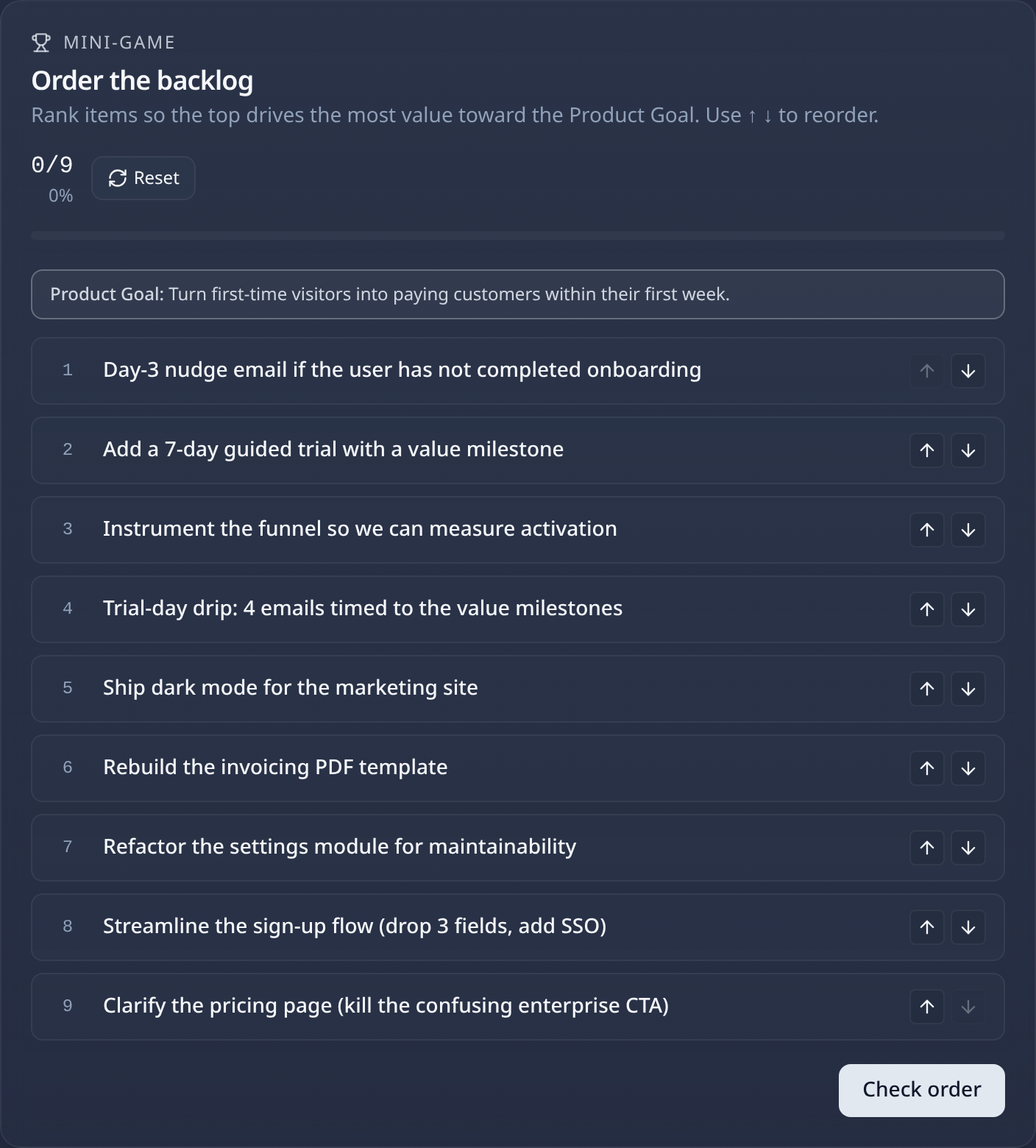
Instrumenting the funnel and refactoring the settings module are both real work. Neither one converts a first-time visitor this week. Once you have felt that trade-off a few times, the exam version of the question stops being a coin flip.
Practice two: hold the Sprint Goal under pressure
The second cluster of exam questions is about what happens when someone with authority wants something mid-Sprint. The Guide gives you two lines: the Sprint Goal does not change during the Sprint, and scope may be clarified and renegotiated with the Product Owner as more is learned. Everything else is judgement.
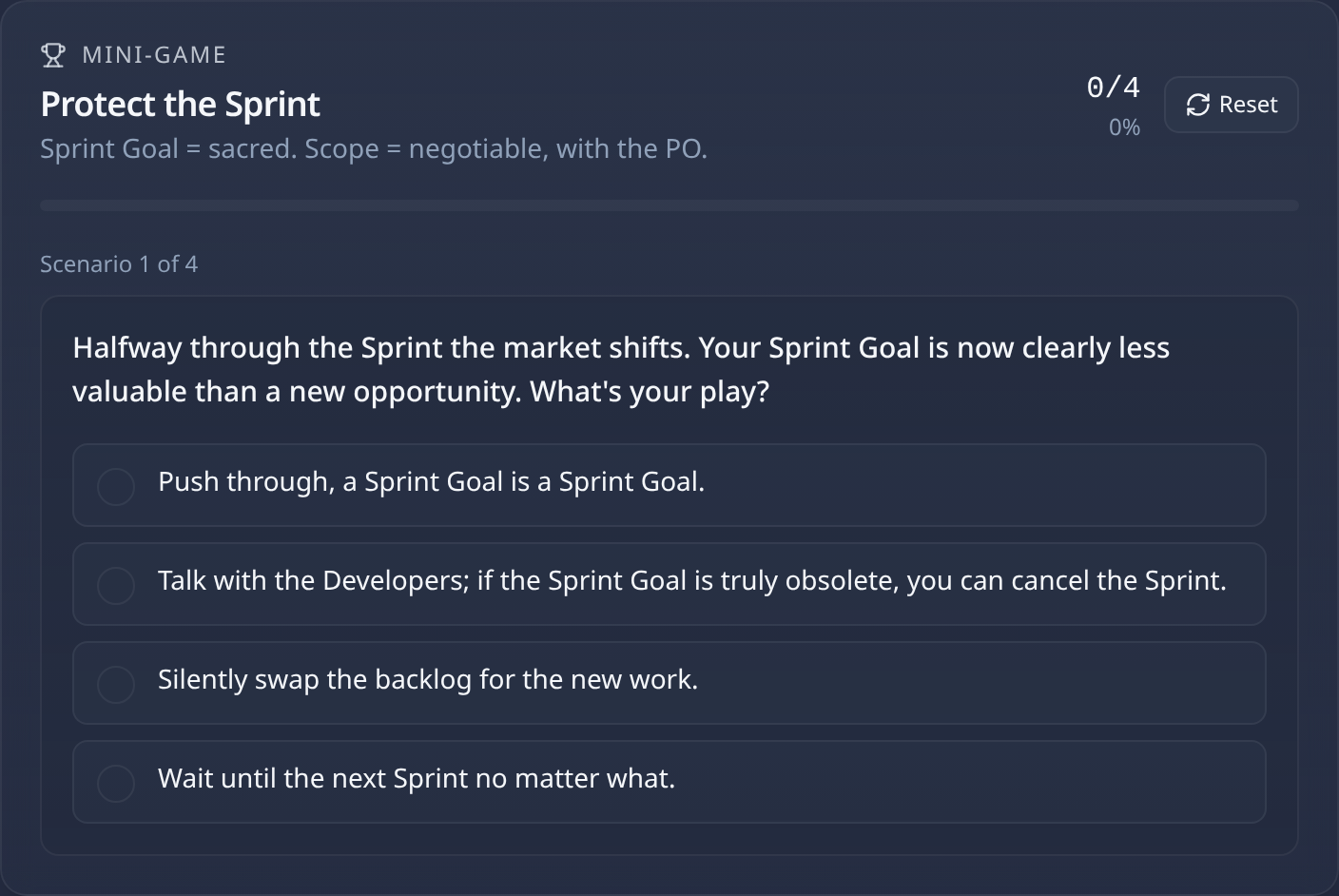
Notice how the options are written. Pushing through a stale Sprint Goal sounds disciplined. Waiting until the next Sprint no matter what sounds respectful of the timebox. Both are wrong, and both are what most teams do. The correct move is to talk with the Developers and, if the goal is genuinely obsolete, use the one lever only the Product Owner has.
A study plan that actually moves the number
- Read the Scrum Guide once more, but read it looking for boundaries and accountabilities rather than definitions.
- Spend most of your preparation time on scenarios, not text. Aim for several hundred decisions, not several more read-throughs.
- Take the Product Owner Open until you score 100 percent twice in a row inside the time limit. If you cannot do that, you are not ready for the paid exam.
- Write down every question you get wrong and the sentence in the Guide that settles it. Review that list, not the whole document.
- Sit the real exam with the Guide open in a second tab, but plan not to use it. Lookup time is the thing that fails people who know the material.
The honest summary
Reading the Scrum Guide five times gets you to the point where you understand every answer once you see it explained. The exam does not explain anything. It gives you 45 seconds and four believable options. Close that gap with reps, not more reading.
Scrumling's Product Owner campaign is free, browser-based, and built entirely out of the decisions the exam asks about. Order the Backlog and Protect the Sprint are two of the mini-games in it.